Writing
Why Undocumented Decisions Lower Your Sale Price
You're making good calls. None of them are recorded.
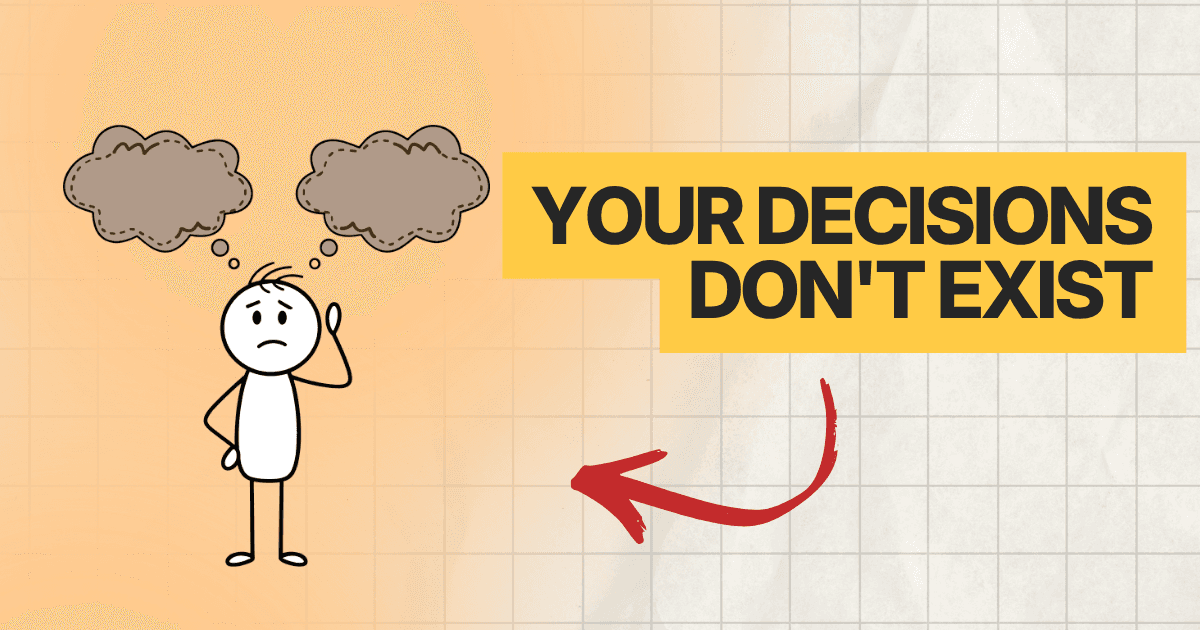
TL;DR: Most founders make solid decisions. The problem is those decisions live in conversations, memories, and Slack threads, not in any durable form. When a buyer looks at your business, they don't just evaluate your results. They evaluate whether your decision-making can survive without you. If it can't be traced, it can't be transferred. And if it can't be transferred, it gets discounted.
The Invisible Operating System
Every founder I know makes dozens of meaningful decisions each week. Pricing adjustments. Vendor choices. Hiring calls. Resource allocation. Strategic pivots. Most of these decisions are good ones. Many of them are excellent.
And almost none of them exist.
They happened in a meeting that wasn't documented. They were ratified in a Slack thread that no one will ever find again. They live in the founder's memory, reconstructed on the fly whenever someone asks "why do we do it this way?"
The decisions are real. But as far as the business is concerned, they never happened. There's no record, no rationale, no trace of the thinking that led to the outcome. Just the outcome itself, sitting there without context.
Why This Matters More Than You Think
Here's what most founders miss. A buyer doesn't just evaluate your numbers. They evaluate the system that produced those numbers. And if that system lives inside your head, it's not a system. It's a dependency.
When a sophisticated acquirer looks at a business, one of the first things they assess is decision quality. Not whether you made the right calls, but whether the organization can make comparable calls without you.
They want to see that the logic behind key decisions is visible, that the reasoning is accessible to the team, and that the pattern can repeat after the founder steps away.
If none of that exists in any documented form, the buyer has to assume the worst. They assume every good outcome was founder-driven. They assume the team can't replicate it. And they price that assumption into the offer.
This isn't about bureaucracy or process for the sake of process. It's about whether your business can prove, to someone who wasn't in the room, that its judgment is institutional and not personal.
The Conversation Trap
Most founder-run businesses operate on what I'd call conversational governance. Decisions are made in real time, communicated verbally, and stored in shared memory. It works beautifully when the founder is present and the team is small enough to have been in the room for most of the history.
It breaks the moment you try to scale, sell, or step back.
New hires can't access the context. Key team members reconstruct decisions from memory, and their versions start to diverge.
The founder becomes the living reference manual for every "why" question, which pulls them deeper into the business at the exact moment they're trying to get above it.
And here's the part that really costs you. Conversational governance looks like agility from the inside. From the outside, it looks like fragility. A buyer sees a business where the institutional knowledge walks out the door with one person, and they adjust their offer accordingly.
What Durable Decisions Look Like
The distinction isn't complicated. A durable decision has three things: the choice that was made, the reasoning behind it, and who owns the outcome going forward. That's it. Not a 40-page report. Not a committee review. Just a clear, findable record that someone other than the founder can reference, learn from, and build on.
The businesses that command premium multiples aren't necessarily making better decisions. They're making decisions that persist beyond the person who made them.
That's what buyers mean when they talk about "management depth." It's not just about having good people. It's about having visible, transferable decision-making that doesn't evaporate when the founder leaves.
My Perspective
The founder who wants to become optional has to do more than delegate tasks. They have to make their thinking visible. Not because documentation is inherently valuable, but because a business that can explain its own reasoning without calling the founder is a business that someone else can run, buy, or scale.
Your decisions are probably good. The question is whether they'll still exist after you leave the room.
— Roland
P.S. SCORE YOUR BUSINESS THE WAY I SCORE ACQUISITIONS
I've evaluated hundreds of companies for acquisition. Most aren't ready, and they don't know it.
Thursday I'm showing founders how I score them, and what it costs them when they score low.
$100. 90 minutes. Once it's done, it's done.
Roland’s Riff
I have an “evil plan” when I work with clients.
It’s not about locking them in, It’s the opposite.
I give them everything they need to solve the problem on their own.
No withholding.
No dependency.
Just clarity and a complete path forward.
And something interesting happens when you do that well.
Want to see how giving everything away actually wins more business? Watch the video below.
Common questions
- Why do undocumented decisions lower my sale price?
- Because a buyer is not just evaluating your results, they are evaluating whether your decision making can survive without you. When your best calls live in conversations, memories, and Slack threads, they do not transfer, and the business looks riskier and worth less.
- How do I make my decision making an asset?
- Give it a durable form. Record the decision, the context, the rationale, and who owns it, so the logic lives in the business instead of in your head. That record is what lets a buyer trust the company will keep making good calls after you leave.
First published in Off the Org Chart.